by Sylvia McNicoll | Aug 25, 2013 | Sylvia McNicoll
What I like about a signing is that it’s a real and demonstrable effort to connect my book to readers without the need to be shortlisted for any prizes, which let’s face it, are hit and miss and certainly out of our control. Here’s something you can do that’s immediate and personal. You invite a potential reader over, tell them about your stories and offer to autograph a copy if they purchase today. They buy or not.
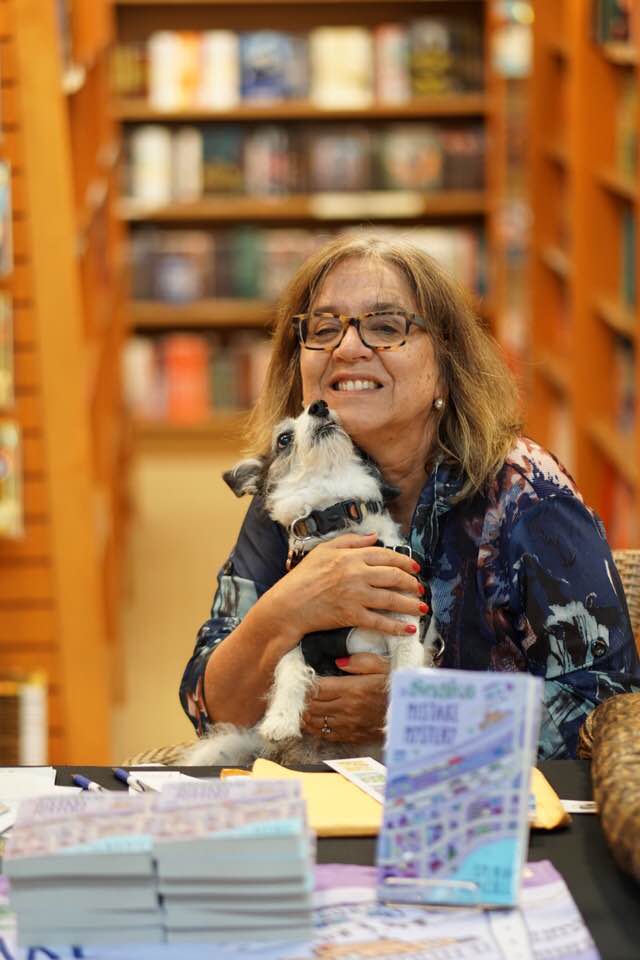
This one is hosted by Kristen Knowles, KZ as she’s known by on her name tag, at Queensway Chapters which is across from Sherway Gardens. She’s a favourite seller of mine who doesn’t require me to submit a job résumé before scheduling a signing. I know she sets up a lovely table with a great book display (Ask me about the time I had to help carry a banquet table though secret shopping centre halls for a smaller chain store appearance)
A problem for today’s event is that the mall is under heavy construction and the regular walkways to the bookstore across the street are obstructed. It’s also a sunny warm day. KZ prefers rainy days for signings.
A plus is KZ and her staff. All of the sales people ask me to tell them about the novels and convince me that they will handsell the books after I’m gone. Regular announcements are made throughout the afternoon about the “Lovely Sylvia McNicoll” “Award winning Candian Author” “In store today, meet her at the back.”
Today, yes, I’m placed at the back of the store near the teen, 9-12 and kids’ section. For the first hour no one comes. But I have great bookmarks. Fitzhenry has just couriered a set of new Bringing Up Beauty/A Different Kind of Beauty/Beauty Returns combo book placeholders. When I see someone of the right age, I walk to them and say something like “I’m a famous Canadian writer. Would you like an autographed bookmark?” Or, tongue in cheek, I address the grownup, “I’m such a famous Canadian author, I can’t understand why your young person hasn’t rushed over for an autograph.” Then I draw them back to the table and chatter about the plots and background information on the covers and stories.
As the day progresses, more customers come in and I realize a plus of where I’m located; the reoccurring phrase: “I’m interested in hearing more but I really have to go the bathroom.”
What can be awkward is when, despite a long and engaging book conversation, the parent and young person walk away with no book. One time a young girl, I want to call her Emma, Olivia or Abby as those were the popular names of the day, kept saying how much all my books interested her. Her mother, a Silver Birch volunteer,
didn’t even seem to think about purchasing one for her. Maybe she has a special discount some where? I know I should shave pressed a little more, but sometimes pride or even nerves kick in.
Another episode involved a mom overly enthusing about me and the books and the child visibly drew further and further away. I think she wanted to hide under the shelves. The mom should have bought a book to read herself and hoped the child would be curious after. Maybe I should have suggested that out loud, but I didn’t want to frighten the kid more. Wish that mom were paired with the girl who wanted all of my books.
At the end of four hours of sitting at a table meeting and greeting strangers, the writer always asks herself is it worth it. Today’s sales net about 17 books.
Yes, yes, yes.
But this is a unique answer to the individual author. This author loves people watching and talking to bookloving parents and kids. I love sitting in between shelves full of colourful books even if they are competition. After all a lot of my friends wrote them. I love getting out and seeing the sales process.
Writing is a solitary experience, signing is social.
In order to do any kind of selling, you have to be convinced that the creation you’re offering is of genuine and unique worth to your reader. Sometimes that’s hard when you’re sandwiched between thousands of books. Or when that book loving Mom still says no. But In the signing experience, I’ve discovered it’s not just the book that’s the product. It’s the meeting the author experience. Parents sometime wax poetic about how wonderful it is that their kids got to talk to a real author. Not
every school brings us in anymore. Kids thank me too or just gape in awe. So for me, it’s no longer just about sales. If I counted, it would be the good conversations I’ve had. What a great afternoon it’s been for that.
For this one summertime Saturday, I didn’t bury myself in my work, arguably a more profitable use of my time. Instead I enjoyed a real social media day.

by Sylvia McNicoll | Jul 27, 2013 | Sylvia McNicoll
After 25 years of published writing, besides feeling more free to creatively stretch my writing fingers, I like to travel the path of mentorship and support. A personal delight of mine has become to welcome and support new writers. It’s very lucky to buy and then have an author sign her early work for you.
Today I took a meandering drive in the country to Fergus in order to attend Lisa Dalrymple (writer)
and Suzanne DelRizzo (illustrator’s) launch of Skink on the Brink (Fitzhenry Whiteside) at Roxanne’s Reflections Book and Card Shop.
Resplendent in a Skink-tail blue dress, (Blue-y and New-y to the children’s literature scene) Lisa talked about the nearly extinct skink showing actual photographs of the creature. Then she launched into a reading. At some point a bright youngster hijacked the story to ask a question and tell a rambling anecdote of her own. Don’t you just love it! Lisa displayed great humour and tact as she told her how much she wanted to hear more AFTER she finished reading Skink on the Brink.

Dressed in a contrasting fuschia (the colour of the head of the skink at maturity?) Suzanne guided the plasticine sculpturing. Young attendants modelled their own skinks and animals.
Did I mention the beautiful cake with all the colourful three D characters of the book perched on top of it? So much energy and activity in both the book and on the cake.

The story follows Stewie’s growth through a close escape from a weasel. It shows his dismay and then his final acceptance of the changes in his body (a tale that metaphorically parallels puberty?) and his return to home and happiness, using narration, rhyme and rhythm. Then when you think you’re done, there’s a couple of pages that instruct on endangered species with more specifics on the skink as well as instructions on how to make Stewie from plasticine. Turn to the final page and be surprised by a lovely sunset farewell to Stewie and his new partner in life.
Well, I needed to buy a copy for each of my three sets of grandchildren and I know I’ll enjoy reading it over and over to them. I am a very lucky writer indeed to be privileged to know so many talented creators both early and further on in their careers. My bookshelves are blessed.
PS The report form Grammarly is that the text was original, however there were 26 critical writing issues giving me a score of 51/100. There were nine issues with contextual spelling, six with grammar including one confusing modifier, two with sentence structure and two with wordiness. Hey, that adds up to only five! With punctuation within a sentence there were three issues. With style and word choice there were six issues with writing style and two with vocabulary. Well, I’m feeling way more confident having used Grammarly. Not.
by Sylvia McNicoll | Jul 14, 2013 | Sylvia McNicoll

Seventeen years ago I won the third ever OLA (Ontario Library Association) Silver Birch Award for Bringing Up Beauty,(Fitzhenry Whiteside) a novel about best friends and boyfriends and fostering a puppy for Guide Dogs Canada. See above on the right my prize which is a braille painting of a silver birch tree. If you run your hands over it, you can feel the image–the perfect award for a book about a future guide dog.
The award is the genius of the OLA to encourage and empower grade four to six students to read and vote for their favourite book from a list of ten librarian-selected Canadian novels. Seventeen years ago, I also met Marsha Skrypuch author of this year’s Silver Birch winner Making Bombs for Hitler (Scholastic Canada). On the left is Marsha’s prize which is a grade six student , Gurleen Randhawa’s drawing and design–a winner of a contest in itself.
In the twenty years since it’s inception, the Silver Birch has morphed into many tree awards for different age groups and readerships. I count eight tree symbols: Blue Spruce, Red Maple, White Pine,Golden Oak, Evergreen, Le Prix Tamarac et Le Prix Peuplier but each may have a nonfiction component, the Silver Birch has an express award. (https://www.accessola.org browse for Forest of Reading)
Along the way, Marsha and I have bumped into each other at many conferences and have driven as well as roomed together, becoming great friends. When the OLA asked Silver Birch authors to create a two minute video to tell how the award has affected us, Marsha and I decided to celebrate together. We asked my son Craig McNicoll, videographer and editor, to create our two minutes professionally.

First Craig set up an impromptu studio in our family room in the basement with lights and cameras. Here he is attaching Marsha’s microphone. Then I acted as interviewer for Marsha asking her the OLA supplied questions in intervals. We repeated some takes so that Craig could edit the best answers together. Then we switched chairs. I had this moment when the hands of time shifted to 1996 when Craig was 14 and he filmed the Silver Birch ceremony even interviewing himself on Beta. I will have to search the tape out and convert it to digital for old times sake.
After the video session (stay tuned for the youtube links when Craig finishes editing) we celebrated again with wine and an impromptu lunch, with our film crew’s family (Eireann, Violet, Desmond) and another local author, Gisela Sherman (Grave Danger, Scholastic Canada). Happy 20th Anniversary Forest of Reading. Thank you to the Ontario Library Association for all the support and readership you have given us. For the alternate version to our years together and the day go to Marsha Skrypuch’s blog http://calla2.com/2013/07/the-tale-of-two-trees/

by Sylvia McNicoll | Jul 5, 2013 | Books, new writing project, part of the writing process, Sylvia McNicoll
I never meant to write about them. The bombsquad using a robot to disengage a backpack “bomb”. A friendly crossing guard who twirls his stop sign like a baton and shares his driving judgements even though he can’t drive himself. And these two dogs, they literally grabbed the story like a stick floating in the water.

Two best friends, sort of, relate in a complicated way. Do they like each other? Mortie will stand up for Worf to the max of his little lung capacity. Worf does not kill Mortie when their respective fangs lock onto the same bone or stick–a huge compliment from a food defensive pound puppy.


The two of them hijacked my story about a dogwalking 12 year old who spots something he shouldn’t have and doesn’t even know it. An emailed threat warns him not to talk to the police. When the police interview him, the criminal kidnaps Worf aka Pong (transformed mysteriously into a greyhound by the way).
“Give me five hundred dollars or the dog dies”. Mortie aka Ping leads his walker in the rescue mission.
by Sylvia McNicoll | Jun 23, 2013 | Sylvia McNicoll
http://bitstrips.com/user/WS25/read.php?comic_id=CS9J9&subsection=1http://

by Sylvia McNicoll | Jun 17, 2013 | Sylvia McNicoll
Brown sugar melting with butter and milk, puckering up and popping a kiss of sweetness into the air, is there anything better? In Dying to Go Viral (Fitzhenry Whiteside) Jade lists making fudge as one of the things she wants to do in the one week do-over of her life. Where did the idea come from?
When I was a kid, the school used to have candy sales to raise money. Everyone was supposed to make and bring in fudge, not something in my mom’s cooking repertoire
Still the night before we would gamely try with the ingredients at hand and without a candy thermometer. We’d watch for the illusive soft ball stage in the candy. Never worked. Mom would roll the results in oatmeal and we’d bring in sticky balls of sweetness. Here’s the scene from the book followed by a great recipe I used for my own book launch treats and an even easier chocolate recipe used by my daughter , JM Filipowicz (author of Wardroids, Double Dragon)
Never Fail Fudge the recipe was called and I had all the ingredients except for evaporated milk but if I just let our regular two percent milk sit awhile, it would evaporate. I left Never Fail on the screen and poured out the milk that it called for.
In a pot I dumped a cup of butter and white sugar with the two cups of brown and then couldn’t be bothered to wait for the milk so I poured it in. You were supposed to boil it to soft ball stage so I’d just boil it longer and the milk would evaporate then.
It didn’t take long. With every bubble that popped from the boiling sugar and milk, a buttery sweet smell released into the air.

I used a cold cup of water and dropped some sugar liquid in. Nope, it barely formed a string. I boiled some more, stirring with a big wooden spoon. Next test, I got a blob, more the shape of a parachute than a ball. Ah, if you could only sky jump from a caramel parachute.

Brown Sugar Fudge
3 cups brown sugar
¾ evaporated milk
1 cup butter
2 cups icing sugar
Boil the brown sugar, milk and butter for 10 minutes. Remove from heat, add the icing sugar and mix for 5 minutes. Spread into greased 8 X 8” pan. Cool before cutting.
The beauty of this recipe is that there’s no thermometer needed and no testing the fudge by wasting droplets of it in a cup of cold water, the way Jade does, the way Mom and I did. A cautionary note, the reviewer of the recipe suggests it doesn’t make much so double up. If you do make a double batch the time for boiling would need to be increased.
An even easier recipe for chocolate fudge is
Chocolate Fudge
3 cups semi sweet chocolate chips
1 can (14 oz) sweetened condensed milk
Melt the two together in the microwave, carefully not to burn. Spread evenly in buttered 8 X 8. Chill for a couple of hours.
The downside is you won’t experience the aroma of the sugar and chocolate in the air.For either recipe you can add vanilla and whatever nuts you are not allergic too.
Enjoy this fudge with feet up as you read a book, preferably Dying to Go Viral. Enter to win one of five free copies at Goodreads.


Recent Comments